The Passy-Muir Valve
This is very simply a one-way valve which is fitted on to the end of a cuff-down tracheostomy tube, in order to allow speech. It was asked about in Question 27.3 from the second paper of 2011. A more detailed exploration is carried out in a comprehensive tribute website which is owned by the manufacturer of the valve. In brief, it is a one-way valve which allows a uni-directional movement of air across a tracheostomy with a completely deflated cuff. Exhaled air comes out through the upper airway, allowing speech, expectoration of secretions, and a more effective cough.
In summary:
|
Indications for use:
Complications of use
|
Contraindications to use
|
Anatomy of the item
This thing is a simple one-way valve.
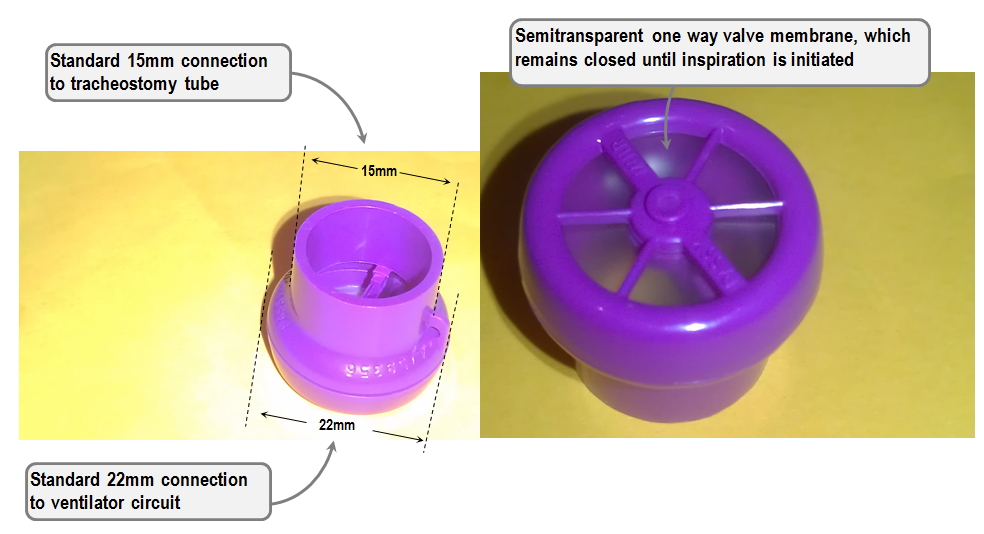
One end plugs into the patient's tracheostomy via a standard connector; the other end can plug into a ventilator, or remain open. The standard connectors make it impossible to reverse the valve (which would have ridiculous consequences)
Details of function
Having one of these on a tracheostomy enables the wearer to speak. Instead of exhaling through the tracheostomy, the closed valve causes air to travel around the tracheal tube and into the vocal cords. This device prevents the need to finger-block one's tracheostomy each time one is inclined to speak or spit.
The fact that the valve remains closed until inspiration begins is helpful, because it keeps a column of air in the trachea, which is under positive pressure while the lungs recoil in expiration. This prevents the aspiration of upper airway secretions and swallowed food or liquids.
References
Dettelbach, Mark A., et al. "Effect of the Passy‐Muir valve on aspiration in patients with tracheostomy." Head & neck 17.4 (1995): 297-302.